Segment duration
20, 40, 60, 80, 100, 200, 500 and 1000 ms.
This project tests whether adapting a smaller audio-language model can beat a larger frozen model when speech evidence is short, noisy, reverberant, or spectrally filtered.
Voice activity detection is usually evaluated on relatively clean, well-segmented audio. This benchmark instead measures how robust speech/non-speech decisions remain when acoustic evidence is deliberately degraded along controlled psychometric dimensions.
20, 40, 60, 80, 100, 200, 500 and 1000 ms.
SNR levels from -10 dB to +20 dB.
RT60 values of 0.0, 0.3, 1.0 and 2.5 seconds.
None, bandpass, lowpass and highpass conditions.
| System | Balanced accuracy | Speech recall | Non-speech recall |
|---|---|---|---|
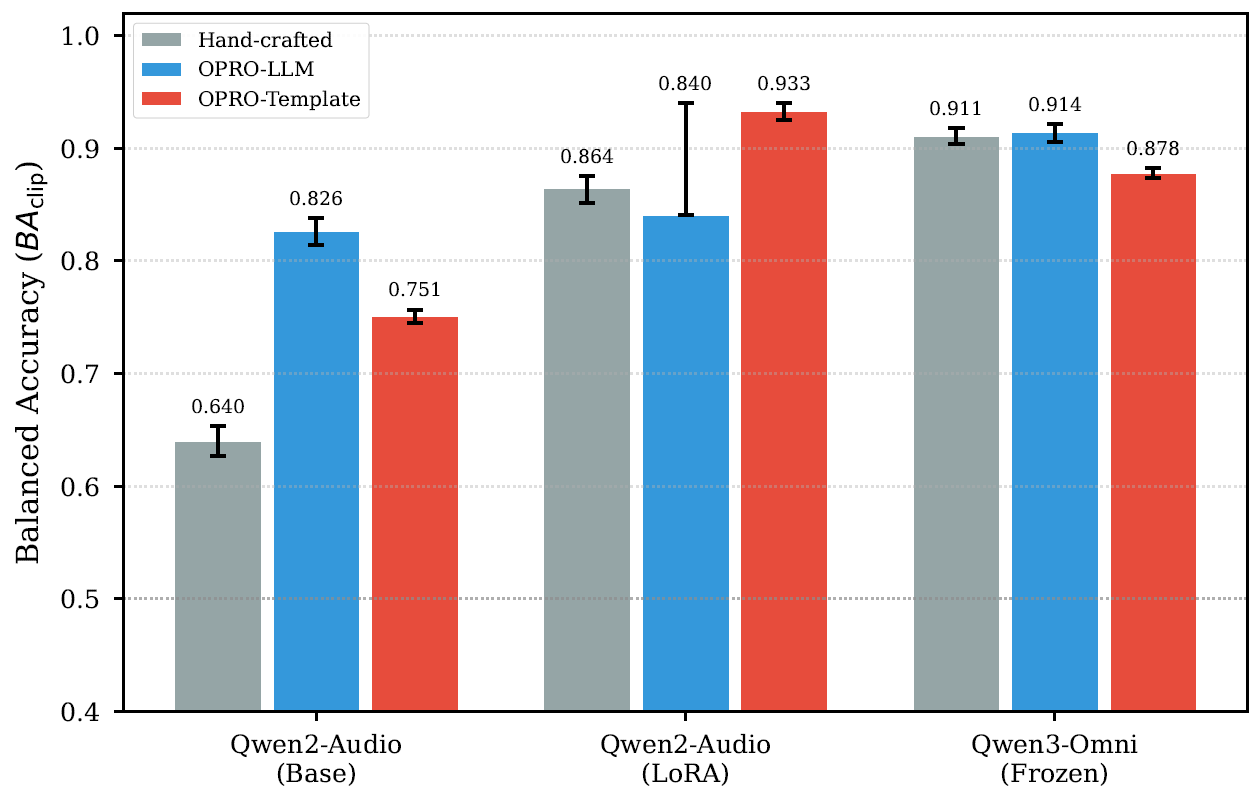
| Qwen2-Audio-7B + OPRO-LLM | 82.6% | 74.7% | 90.6% |
| Qwen2-Audio-7B + LoRA + OPRO-Template | 93.3% | 92.8% | 93.8% |
| Qwen3-Omni-30B frozen + hand prompt | 91.1% | 87.4% | 94.7% |
| Silero VAD | 88.9% | 78.8% | 99.1% |
The strongest balanced result came from the adapted 7B model rather than the larger frozen 30B model. Silero remained the most conservative system, with very high non-speech recall but lower speech recall.
LoRA + OPRO-Template reaches DT90 = 96 ms, approximately the amount of audio required to reach 90% balanced accuracy.
LoRA adaptation produces a more stable robustness profile under additive noise than prompt optimization alone.
Human and animal vocalizations are important confounders. Laughing, coughing and crying-baby clips remain difficult non-speech cases.
The experiment provides a concrete counterexample to the assumption that the largest frozen audio-language model necessarily gives the strongest VAD result.
The public repository contains the experiment configuration, evaluation scripts, fine-tuning code, prompt-optimization scripts, consolidated metrics, statistical analyses, figures, LaTeX tables and audit reports used to reconstruct the headline results.